
Validity vs Reliability in Surveys: Difference & Examples
Validity and reliability mean different things in survey research. Definitions, side-by-side comparison, and how to design surveys with both.
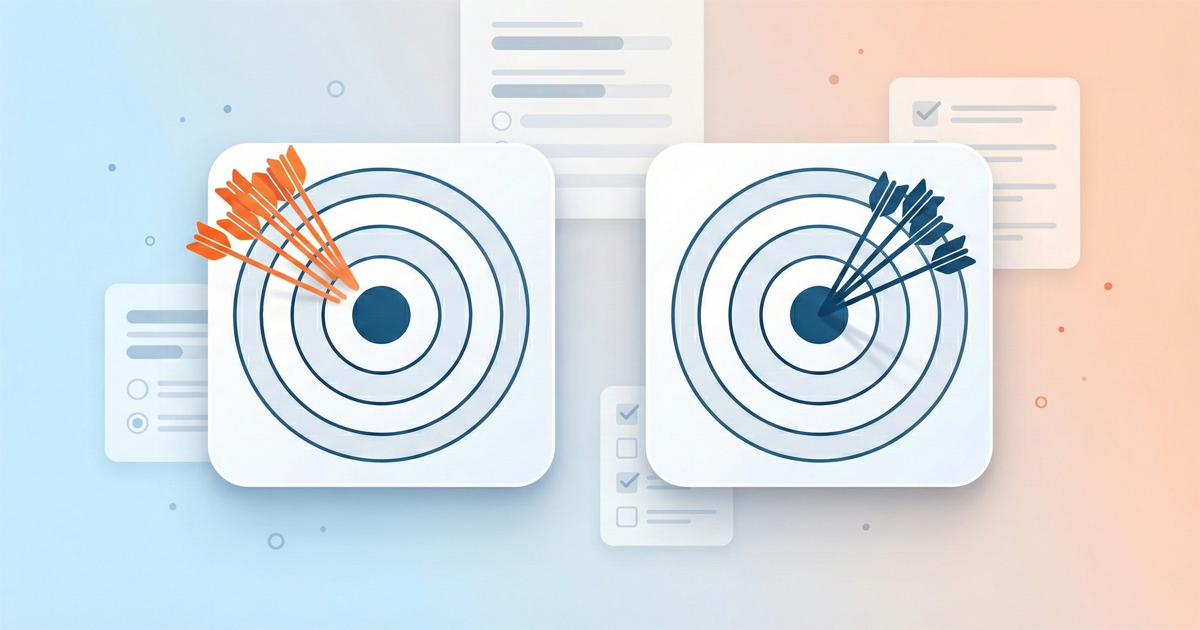
Reliable data can still be wrong. A survey can produce the same results every time and still measure the wrong thing entirely.
Survey validity is the degree to which a survey actually measures what it claims to measure. Survey reliability is the degree to which it produces consistent results. These two concepts are the foundation of measurement quality, and confusing them is one of the most common mistakes in survey research.
The distinction matters because you can have one without the other. A bathroom scale that consistently reads 3kg too heavy is highly reliable but not valid. It gives you the same wrong answer every time. Conversely, a scale that fluctuates wildly might occasionally hit the correct weight but can't be trusted because it's unreliable.
This guide explains what validity and reliability actually mean, why they're so often confused, and how to design surveys that achieve both.
TL;DR:
- Validity: Does the survey measure what it's supposed to measure? This is about accuracy and meaning.
- Reliability: Does the survey produce consistent results? This is about stability and repeatability.
- The trap: Surveys can be reliable without being valid. Consistency doesn't guarantee correctness.
- Four validity types matter: Face, content, construct, and criterion validity each address different aspects of measurement quality.
- Reliability is easier to achieve: Internal consistency and test-retest reliability can be measured statistically. Validity requires judgment.
- Design affects both: Question wording, construct definition, branching logic, and pilot testing all influence measurement quality.
→ Build Better Surveys with Lensym
What Validity and Reliability Actually Mean
These terms have precise meanings in research methodology that differ from everyday usage.
Validity: Are You Measuring the Right Thing?
Validity answers the question: "Does this survey actually capture what I think it captures?"
A customer satisfaction survey has high validity if it genuinely measures how satisfied customers are with your product. It has low validity if it actually measures something else, like how much customers like your brand in general, or how polite they're being, or how rushed they feel.
Validity is fundamentally about meaning. When you report that "78% of customers are satisfied," validity determines whether that statement reflects reality or is essentially meaningless.
Reliability: Are You Measuring It Consistently?
Reliability answers the question: "Would this survey give me the same results if I ran it again?"
A survey has high reliability if the same person, answering the same questions under similar conditions, would give similar responses. It has low reliability if responses vary unpredictably, making it impossible to distinguish real differences from measurement noise.
Reliability is fundamentally about stability. When you report that satisfaction dropped from 78% to 65%, reliability determines whether that change is real or just random fluctuation.
Why They're Constantly Confused
The confusion stems from an intuitive but false assumption: that consistent results must be correct results.
Consider a personality assessment that always categorizes you as "highly extroverted" every time you take it. The consistency feels like proof that the test works. But what if the questions are actually measuring your current mood, or your desire to seem sociable, or your reading comprehension? The test is reliable (consistent) but not valid (measuring the wrong thing).
The classic illustration is a target:
| Scenario | Pattern | Validity | Reliability |
|---|---|---|---|
| Shots clustered in bullseye | Tight group, center | High | High |
| Shots clustered off-center | Tight group, wrong spot | Low | High |
| Shots scattered around bullseye | Wide spread, centered | High | Low |
| Shots scattered everywhere | Wide spread, off-center | Low | Low |
The most dangerous scenario is the second one: shots that consistently miss in the same direction. You'd never know you were wrong because your results are so consistent. We've seen teams make major product decisions based on survey data that was impressively reliable and completely invalid.
The Four Types of Validity That Matter in Surveys
Validity isn't a single property. Different types address different questions about whether your measurement is meaningful.
Face Validity: Does It Look Right?
Face validity is the simplest form: does the survey appear to measure what it claims to measure?
A job satisfaction survey has high face validity if respondents read the questions and think, "Yes, these are about job satisfaction." It has low face validity if respondents wonder, "What does this have to do with my job?"
Face validity matters because:
- It affects respondent engagement (people take relevant-seeming surveys more seriously)
- It provides a basic sanity check
- Stakeholders need to trust that the survey makes sense
But face validity is the weakest form of validity. A survey can look perfectly reasonable while completely missing the construct it claims to measure.
Content Validity: Does It Cover Everything?
Content validity asks whether the survey covers the full range of the concept being measured.
A customer satisfaction survey has high content validity if it addresses all relevant dimensions: product quality, customer service, pricing, delivery, ease of use, and so on. It has low content validity if it only asks about one aspect while claiming to measure overall satisfaction.
To assess content validity:
- Define the construct clearly (what exactly is "customer satisfaction"?)
- Identify all relevant dimensions
- Ensure each dimension is adequately represented in questions
- Have subject matter experts review coverage
Content validity failures are common when surveys are rushed or when researchers assume they know what matters without checking. This happens constantly, and it's almost always avoidable with one conversation with actual users before writing questions.
Construct Validity: Does It Measure the Abstract Concept?
Construct validity is the most important and most difficult form. It asks whether the survey actually captures the underlying concept (construct) it's designed to measure.
Many concepts we want to measure, like satisfaction, engagement, loyalty, or anxiety, are abstractions. They can't be observed directly. We measure them through indicators (survey questions) that we believe reflect the underlying construct.
A survey has high construct validity if:
- Questions that should correlate with each other actually do (convergent validity)
- Questions that should not correlate with unrelated concepts actually don't (discriminant validity)
- Results behave as theory predicts they should
For example, a "customer loyalty" survey has construct validity if:
- Loyalty scores correlate with actual repeat purchases
- Loyalty scores don't simply mirror satisfaction scores (it's measuring something distinct)
- Customers who score high on loyalty behave differently than those who score low
Construct validity is where most surveys fail. It requires clear theoretical thinking about what you're actually trying to measure.
Criterion Validity: Does It Predict Real Outcomes?
Criterion validity asks whether survey results correlate with external outcomes that the construct should predict.
There are two types:
- Concurrent validity: Do current survey results correlate with current real-world measures?
- Predictive validity: Do current survey results predict future outcomes?
A job satisfaction survey has high criterion validity if satisfaction scores correlate with actual turnover rates. An employee engagement survey has high predictive validity if engagement scores predict future productivity.
Criterion validity is powerful because it connects your abstract measurement to concrete reality. The challenge is identifying appropriate criteria and having access to the data needed to validate.
What Reliability Actually Measures
While validity is about meaning, reliability is about measurement precision. There are two main types relevant to surveys.
Internal Consistency: Do Related Questions Agree?
Internal consistency measures whether questions designed to assess the same construct produce similar responses.
If you have five questions all measuring "job satisfaction," respondents who agree with one should generally agree with the others. If someone is "very satisfied" on question 1 but "very dissatisfied" on question 3, either the questions are measuring different things or one of them is poorly worded.
Internal consistency is typically measured using Cronbach's alpha, a coefficient ranging from 0 to 1. Values above 0.7 are generally considered acceptable; above 0.8 is good.
However, high internal consistency can be misleading. Questions might agree with each other simply because they're redundant (asking the same thing in slightly different words) rather than because they're capturing a coherent construct.
Test-Retest Reliability: Do Results Stay Stable?
Test-retest reliability measures whether the same survey produces similar results when administered to the same people at different times.
If you survey the same customers about satisfaction today and again next week (assuming nothing has changed), a reliable survey should produce similar results. Large fluctuations suggest that responses are influenced by transient factors like mood, time of day, or question interpretation.
Test-retest reliability is measured by correlating scores from the two administrations. Correlations above 0.7 indicate acceptable stability.
The challenge is distinguishing unreliability from genuine change. If satisfaction scores differ between administrations, it might be measurement error, or customers might actually have become more or less satisfied.
Why Reliability Is Easier to Achieve Than Validity
Reliability can be measured statistically. You can calculate Cronbach's alpha or run a test-retest study and get a number. Validity requires judgment. You have to reason about whether your questions actually capture the concept you're trying to measure.
This asymmetry creates a dangerous bias in survey design. Researchers can easily demonstrate reliability ("Our survey has α = 0.89!") but rarely have evidence for validity. The result is surveys that are impressively consistent but measure the wrong thing. If you've ever had survey results that didn't match reality and couldn't figure out why, this is usually the reason.
How You Get Reliability Without Validity
Several common practices produce surveys that are reliable but not valid.
Leading Questions
Questions that push respondents toward particular answers produce consistent results because everyone is being pushed the same way:
| Leading (Reliable but Invalid) | Neutral (Valid) |
|---|---|
| "How satisfied are you with our excellent customer service?" | "How would you rate our customer service?" |
| "Don't you agree that our product saves time?" | "Has using our product affected the time you spend on this task?" |
Leading questions don't measure attitudes; they measure compliance with suggestion.
Overly Narrow Constructs
Defining your construct too narrowly makes it easier to measure consistently but may miss what actually matters:
A "customer experience" survey that only asks about transaction speed will be highly reliable (speed is easy to assess consistently) but may miss that customers actually care about feeling valued, having problems resolved, or not being transferred repeatedly.
Over-Polished Scales
Lengthy scales with many similar items tend to have high internal consistency because respondents develop a response pattern and stick with it. By question 15 of a 20-item scale, they're often just maintaining consistency with their earlier answers rather than carefully considering each item.
This produces impressive alpha coefficients but inflated reliability estimates.
Excessive Agreement Formats
Agree/disagree formats (Likert scales) are prone to acquiescence bias, where respondents tend to agree regardless of content. This creates artificial consistency across items while obscuring actual attitudes.
Mixing positively and negatively worded items can help, but introduces its own problems when respondents don't notice the reversal.
Design Choices That Improve Both Validity and Reliability
Good survey design enhances both measurement properties simultaneously.
Define Your Construct Clearly
Before writing any questions, articulate exactly what you're trying to measure:
- What is the construct conceptually?
- What are its dimensions?
- What would high vs. low scores actually mean?
- How does this construct relate to (and differ from) similar concepts?
Vague constructs produce invalid surveys because you can't measure something you haven't defined.
Use Neutral Wording
Questions should not suggest preferred answers. Review every question for:
- Loaded terms ("excellent," "problematic," "innovative")
- Implicit assumptions ("Since you value quality...")
- Social desirability pressure (questions where there's an obviously "right" answer)
Neutral wording improves validity by capturing actual attitudes rather than response bias.
Use Branching Logic to Improve Relevance
Branching logic routes respondents to questions that actually apply to them. This improves validity by ensuring people only answer questions they can meaningfully respond to.
A product feedback survey that asks non-users about feature satisfaction produces invalid data. Branching logic ensures the question only appears for actual users.
Branching also improves reliability by reducing frustration and satisficing (giving careless answers to finish faster).
Pilot Test with Cognitive Interviews
Before launching, test your survey with a small group while asking them to think aloud:
- What do they think each question is asking?
- How are they arriving at their answers?
- Which questions seem confusing, irrelevant, or awkward?
This reveals validity threats (questions interpreted differently than intended) and reliability threats (questions that produce inconsistent interpretations).
Reduce Bias
Many forms of survey bias directly threaten validity:
- Social desirability bias makes responses reflect what seems acceptable rather than actual attitudes
- Order effects make responses depend on question sequence rather than true opinions
- Question wording bias measures reactions to phrasing rather than underlying attitudes
Bias reduction is validity improvement.
What Tools Can and Can't Do
Survey tools can help with reliability more than validity.
Tools Can Help Reliability
- Randomization reduces order effects
- Consistent formatting reduces interpretation variation
- Skip logic prevents irrelevant questions that cause satisficing
- Progress indicators reduce abandonment and rushed responding
- Mobile optimization ensures consistent experience across devices
These features help ensure respondents experience the survey consistently and respond thoughtfully.
Validity Is a Design and Interpretation Problem
No tool can tell you whether your questions actually measure what you think they measure. That requires:
- Clear thinking about your construct
- Domain knowledge about what matters
- Understanding of your respondent population
- Honest assessment of what your data can and can't tell you
Tools can help you execute a survey well. They can't help you design the right survey in the first place.
Lensym's visual editor and conditional logic help you build surveys that work as designed. But the validity of your measurement depends on the thinking you do before you start building.
Pre-Launch Validity and Reliability Checklist
Use this checklist before launching any survey:
Validity Checks
- Construct definition: Can you articulate in one sentence exactly what you're measuring?
- Content coverage: Does the survey address all relevant dimensions of the construct?
- Question review: Is each question clearly related to what you're trying to measure? (Avoid questions you should never ask.)
- Neutral wording: Have you removed leading language and loaded terms?
- Expert review: Has someone with domain knowledge reviewed the questions?
- Cognitive testing: Have you tested with real respondents to check interpretation?
Reliability Checks
- Similar questions agree: Do questions measuring the same thing point the same direction?
- Clear wording: Can questions be interpreted only one way?
- Appropriate difficulty: Are questions answerable without guessing?
- Consistent format: Does the survey present consistently across devices?
- Reasonable length: Will respondents complete thoughtfully without rushing?
Both Validity and Reliability
- Pilot tested: Have you run a small-scale test and reviewed the data?
- Branching logic: Do respondents only see relevant questions?
- Bias review: Have you checked for the major bias types?
- Stakeholder alignment: Do decision-makers agree on what the survey measures?
The Bottom Line
Validity and reliability are both essential, but validity is more important and harder to achieve.
A reliable but invalid survey gives you consistent wrong answers. An unreliable but valid survey gives you noisy data about the right thing. The second is salvageable with larger samples; the first is not.
The practical implication: spend more time on construct definition and question design (validity) and less time obsessing over scale length and coefficient alpha (reliability).
Before you launch, ask: "If this survey shows [result X], what would that actually mean?" If you can't answer clearly, you have a validity problem. Fix it before you collect data you can't interpret.
Ready to build surveys that measure what matters?
Lensym's visual editor helps you design clear, logical surveys with built-in features for branching logic, randomization, and bias reduction.
For more on measurement quality, see the World Health Organization's guidelines on questionnaire design and Scribbr's guide to reliability vs. validity.
About the Author
The Lensym Team builds survey research tools for people who care about measurement quality. We believe that valid, reliable research shouldn't require a statistics degree, just thoughtful tools that make good design practices accessible.
On this page
Continue Reading
More articles you might find interesting

Acquiescence Bias: What It Is, Examples & How to Reduce
Acquiescence bias is the tendency to agree regardless of content. Real survey examples, why it happens, and the methods that reliably reduce it.

Anonymous Surveys and GDPR: What Researchers Must Document
GDPR's definition of anonymity is strict. Requirements for true anonymization, when pseudonymization suffices, and documentation obligations for each.
Central Tendency Bias: What It Is, Examples & How to Prevent
Central tendency bias is when respondents cluster on middle scale options. Examples, why it happens on Likert scales, and how to prevent it.