
When Surveys Are the Wrong Tool (And What to Do Instead)
When surveys are the wrong method: interviews, observation, behavioral/secondary data, and mixed methods—plus criteria to choose appropriately.
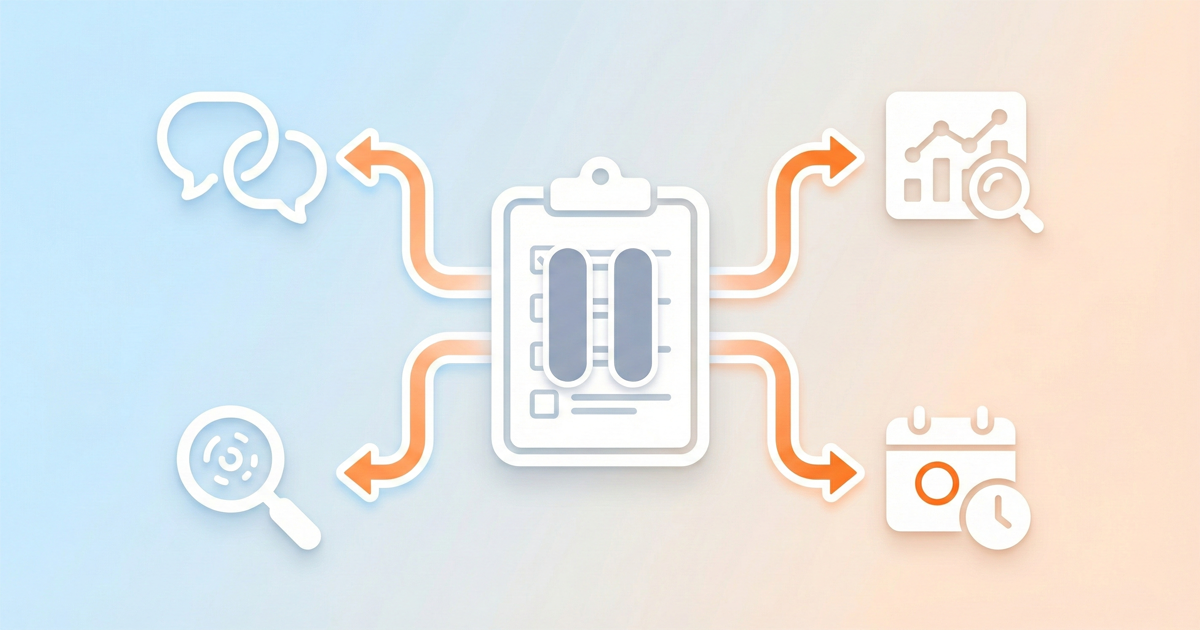
We build survey tools. We’re also here to tell you when not to use them.
Surveys are powerful. They scale. They're relatively cheap. They produce quantifiable data that stakeholders find reassuring.
They're also overused.
Not every research question is a survey question. Sometimes a survey will give you data that looks useful but leads you in the wrong direction. Sometimes the act of asking a question changes what people would naturally do. Sometimes you just don't know enough yet to ask good questions.
Here's when surveys are the wrong tool, and what to do instead.
When You Don't Know What to Ask
Surveys are confirmation tools, not discovery tools.
A survey can tell you how many people prefer option A vs option B. It can't tell you what options exist in the first place. It can't surface problems you haven't thought of. It can't reveal the language your users actually use to describe their experience.
If you're exploring a new problem space, a survey will give you answers to questions that might not matter. You'll feel productive. You'll have data. But you'll have learned less than if you'd talked to five people.
Do this instead: Start with interviews. 5-8 qualitative conversations will reveal patterns, language, and priorities you'd never have thought to ask about. Then build your survey based on what you learned.
We've seen teams skip this step, launch surveys with confident-sounding questions, and end up with clean data that completely missed what users actually cared about.
When Behavior Data Already Exists
Asking people what they do is less reliable than observing what they actually do.
If you want to know which features people use, check your analytics. If you want to know how long people spend on a task, measure it. If you want to know whether people click the button, look at the click data.
Surveys measure stated behavior and stated preferences. These are filtered through:
- Memory (inaccurate)
- Social desirability (biased toward "good" answers)
- Self-perception (people believe things about themselves that aren't true)
Behavioral data has none of these problems. It's what people actually did, not what they say they did.
Do this instead: Before designing a survey, ask: "Do we already have data that answers this?" Often, the answer is in your analytics, CRM, or product logs. Surveys should fill gaps, not duplicate what you can observe directly.
When The Question Is "Why"
Surveys are good at what and how much. They're weak at why.
You can ask "Why did you cancel?" and people will give you answers. But those answers are post-hoc rationalizations, not accurate causal explanations. People don't have reliable insight into their own decision-making processes.
A customer might say they canceled because of price. But maybe price was just the most socially acceptable reason. Maybe the real reason was they never figured out a key feature, or their needs changed, or a competitor reached out at the right moment. They might not even know.
Do this instead: Use interviews for "why" questions. A skilled interviewer can probe, follow up, notice hesitations, and dig beneath surface explanations. Surveys give you the first answer; interviews give you the real one.
Or: don't ask why at all. Instead, look for patterns in behavior that precede the outcome you're studying. What did churned users do differently in their first week? That's often more useful than asking them to explain themselves.
When Timing Is Wrong
Some questions can't be answered accurately in retrospect.
Asking someone how they felt during an experience after the experience is over gives you their reconstructed memory, not their actual experience. Memory is biased toward peaks, endings, and emotionally significant moments. The mundane middle gets compressed or forgotten.
Do this instead: Capture experience in the moment. In-app feedback during the task. Diary studies that prompt daily reflection. Intercept surveys at the point of experience, not weeks later.
If you must ask retrospectively, anchor to specific recent events ("Think about the last time you...") rather than general impressions ("How do you usually feel when...").
When Stakes Are High and Sample Is Small
Surveys produce statistical confidence. But statistics require sample size.
If you're researching a small population (enterprise buyers, niche specialists, executives), you might only get 15-30 responses. That's not enough for meaningful quantitative analysis. Confidence intervals will be wide. Segments will be too small to compare. You'll have numbers, but they won't mean much.
Do this instead: With small populations, go qualitative. Interviews let you go deep with the people you can reach. You'll learn more from 12 thoughtful interviews than from 25 checkbox responses.
Alternatively, accept that the survey is exploratory, not conclusive. Use it to generate hypotheses, not to prove them.
When You're Surveying to Feel Productive
This is the uncomfortable one.
Sometimes teams run surveys because it feels like progress. You're doing research. You're gathering data. You're being customer-centric. It looks good in a status update.
But if you don't have a specific decision the survey will inform, if you can't articulate what you'll do differently based on the results, the survey is theater.
Ask yourself: "If this survey shows [result X], what will we do?" If you can't answer that clearly, you're not ready to survey.
When Surveys Are Right
Surveys work well when:
- You have clear hypotheses to test
- You need to quantify something across a population
- You've done qualitative work first and know what matters
- You have enough sample size for statistical confidence
- The questions can be answered accurately via self-report (watch for bias)
- You know what decision the data will inform
When those conditions are met, surveys are excellent. Fast, scalable, affordable.
When they're not, surveys give you confident-looking data that leads you astray. That's worse than having no data at all.
Building surveys that actually inform decisions?
Lensym helps you design research-grade surveys with visual logic, bias reduction, and clear paths to insight.
About the Author
The Lensym Team builds survey tools and believes strongly that surveys aren't always the answer. Sometimes the best survey advice is: don't survey yet.
On this page
Continue Reading
More articles you might find interesting

Acquiescence Bias: What It Is, Examples & How to Reduce
Acquiescence bias is the tendency to agree regardless of content. Real survey examples, why it happens, and the methods that reliably reduce it.

Anonymous Surveys and GDPR: What Researchers Must Document
GDPR's definition of anonymity is strict. Requirements for true anonymization, when pseudonymization suffices, and documentation obligations for each.
Central Tendency Bias: What It Is, Examples & How to Prevent
Central tendency bias is when respondents cluster on middle scale options. Examples, why it happens on Likert scales, and how to prevent it.